

CONTRIBUTORS

Chuck Royce
Chairman, Portfolio Manager

Francis Gannon
Co-Chief Investment Officer, Managing Director
Investors are understandably nervous these days, which is no surprise given how many important questions currently have no firm answers. Will the U.S. economy stumble into a recession, or have we already been through the worst of the slowdown? When will a more robust recovery begin? When will inflation subside more meaningfully? Will the Federal Reserve (Fed) pause, pivot, or hike? When, and in what way, will the Russia-Ukraine conflict end—and how will its outcome affect geopolitics and the global economy? Will reshoring, the infrastructure bill, and/or the CHIPS and Science Act have a measurably positive impact on our economy? If so, when? To be sure, through our more than five decades of asset management, we have seldom seen a period so full of uncertainty as the present, barring periods of widespread crisis.
From our perspective, the uncertain present offers a highly opportune time to invest in small caps for the long run.
It is during such challenging days that having a long-term investment horizon seems particularly relevant. And taking the long view may be even more relevant for small caps because of their well-established habit of emerging from long-term periods with low or negative performance to those with higher-than-average long-term returns. For example, when the Russell 2000 Index’s annualized five-year returns were less than 5%, subsequent three-year periods had positive returns 100% of the time, in all 84 periods, and averaged 17.7%, which was well above the index’s monthly rolling average three-year return of 9.8% since the Russell 2000’s 12/31/78 inception.
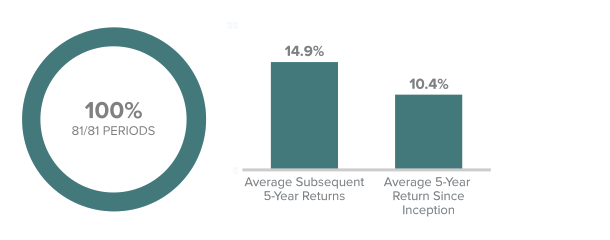
Results for the five-year periods were equally encouraging following five-year periods when the small-cap index had annualized returns of less than 5%. The Russell 2000 had positive annualized five-year returns 100% of the time—in all 81 five-year periods—with an impressive 14.9% average, which was well above its monthly rolling five-year return since inception of 9.6%. We think that these patterns are especially relevant now because the respective three- and five-year annualized returns for the Russell 2000 as of 5/31/23 were 9.2% and 2.7%. (It should also be noted that the below average three-year number’s starting point was not long after the market began to speedily recover from its Covid-driven bottom on 3/18/20.)
A High Probability of Positive Small-Cap Performance Ahead?
Subsequent Average Annualized 5-Year Performance for the Russell 2000 Following 5-Year Annualized Return Ranges of Less Than 5% from 12/31/83 through 3/31/23
Source: Russell Investments. Past performance is no guarantee of future results.
We were curious, however, to see if this pattern would hold if we included periods before the 1978 inception of the Russell 2000—which led us to examine performance for the CRSP 6-10 Index, the small-cap proxy we use when we want to analyze data that precedes the inauguration of the Russell indexes. We began our analysis, as we typically do, after the end of the Second World War. We found that that from 12/31/45 through 3/31/23 there were 135 five-year periods when the CRSP 6-10 returned less than 5% on an annualized basis. Subsequent one-year periods were positive 84% of the time, in 113 periods, with an average return of 26.7%—which was well ahead of the 14.4% average for all 868 one-year periods.
The story was similarly positive for the 132 three-year periods that followed five-year spans with annualized returns of less than 5%. In 95% of these three-year periods, a total of 125, subsequent annualized returns were positive, averaging 20.7%. Once again, the annualized returns coming out of a poor five-year period were much higher than the overall average, in this case beating the CRSP 6-10’s three-year annualized average return of 12.9% for all 832 periods since the end of 1945.
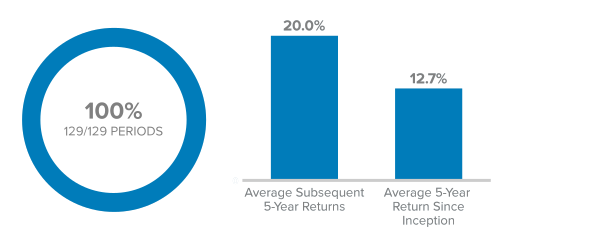
We next looked at the 129 five-year periods when the CRSP 6-10 averaged less than 5% on an annualized basis that also had a subsequent five-year return. The subsequent annualized five-year return was positive in all 129 periods—another 100% mark for small caps. The five-year average annualized return for the 129 periods was an impressive 20.0%—markedly better than the overall 12.6% average return for the 808 five-year periods spanning 12/31/45-3/31/23.
Taking the Long View of Small-Cap Performance
Subsequent Average Annualized Five-Year Performance for the CRSP 6-10 Following 5-Year Return Ranges of Less Than 5% from 12/31/45 through 3/31/23
Source: Russell Investments. Past performance is no guarantee of future results.
We believe that the historical pattern, over more than 75 years, of positive small-cap performance coming out of long-running periods of low or negative returns merits consideration, especially at a time when many small cap stocks look attractively valued to us on both an absolute basis and relative to large-cap stocks. From our perspective, the uncertain present offers a highly opportune time to invest in small caps for the long run.
Definitions
The CHIPS and Science Act is a U.S. federal statute enacted by the 117th United States Congress and signed into law by US President Joe Biden on August 9, 2022. The act provides roughly $280 billion in new funding to boost domestic research and manufacturing of semiconductors in the United States.
The Russell 2000 Index is an index of domestic small-cap stocks that measures the performance of the 2,000 smallest publicly traded U.S. companies in the Russell 3000 Index.
The Center for Research in Security Prices (CRSP) equally divides the companies listed on the NYSE into 10 deciles based on market capitalization. Deciles 1-5 represent the largest domestic equity companies and Deciles 6-10 represent the smallest. CRSP then sorts all listed domestic equity companies based on these market cap ranges. By way of comparison, the CRSP 1-5 would have similar capitalization parameters to the S&P 500 and the CRSP 6-10 would have similar capitalization parameters to those of the Russell 2000.
WHAT ARE THE RISKS?
Past performance is no guarantee of future results. Please note that an investor cannot invest directly in an index. Unmanaged index returns do not reflect any fees, expenses or sales charges.
Equity securities are subject to price fluctuation and possible loss of principal. Fixed-income securities involve interest rate, credit, inflation and reinvestment risks; and possible loss of principal. As interest rates rise, the value of fixed income securities falls. International investments are subject to special risks including currency fluctuations, social, economic and political uncertainties, which could increase volatility. These risks are magnified in emerging markets. Commodities and currencies contain heightened risk that include market, political, regulatory, and natural conditions and may not be suitable for all investors.
U.S. Treasuries are direct debt obligations issued and backed by the “full faith and credit” of the U.S. government. The U.S. government guarantees the principal and interest payments on U.S. Treasuries when the securities are held to maturity. Unlike U.S. Treasuries, debt securities issued by the federal agencies and instrumentalities and related investments may or may not be backed by the full faith and credit of the U.S. government. Even when the U.S. government guarantees principal and interest payments on securities, this guarantee does not apply to losses resulting from declines in the market value of these securities.
Data and figures quoted in this article sourced from Russell Investments, Bloomberg and Reuters.