
CONTRIBUTORS

John Levy
Director of Impact, Franklin Real Asset Advisors

Raymond Jacobs
Managing Director,
New York
Franklin Real Asset Advisors
Buildings with a civic and social purpose underpin our economies. At Franklin Real Asset Advisors, we define these physical assets as social infrastructure. Examples of social infrastructure include hospitals, schools, affordable housing and buildings related to justice, emergency and civil services.
Why private investors have a role to play now?
These vital assets have suffered from underinvestment and public investment is not enough to meet society’s increasing needs. Social infrastructure has emerged as an opportunity for real estate investors looking to achieve powerful social and environmental impact, in addition to financial benefits.
Our impact investing approach
While investing in these types of assets could appear intuitively impactful, a true impact strategy requires standards and data that can be measured and reported in a transparent way. As shown in our annual report, we have designed a fully integrated impact management and measurement system that aligns with many global standards, including the United Nations Sustainable Development Goals and International Finance Corporation’s (IFC) Operating Principles for Impact Management to name a few. This report also includes specific examples about our work to date, illustrated by key data and case studies.
Not all the world’s problems can be directly addressed through impact investing, and even fewer can be addressed in a market-rate, core real estate strategy. However, much more can be done than at present. We hope to be a part of a paradigm shift where profit-seeking capital can directly address some of these problems.
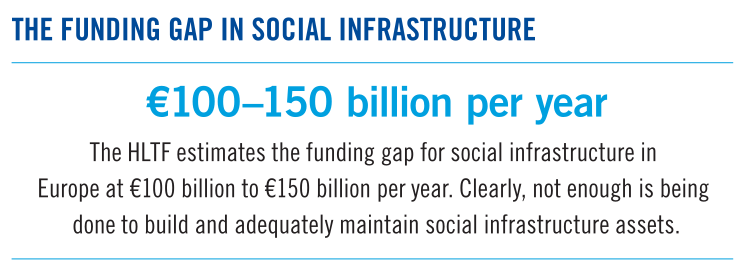
Source: Boosting Investment in Social Infrastructure in Europe, Report of the High-Level Task Force on Investing in Social Infrastructure in Europe, European Commission, As of January, 2018
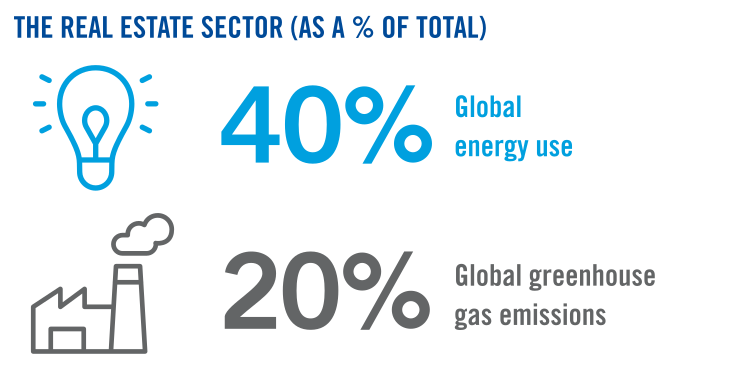
Source: “Environmental Sustainability Principles for the Real Estate Industry” World Economic Forum (WEF), World Economic Forum Industry Agenda Council on the Future of Real Estate & Urbanization and World Bank January 2016. For illustrative purposes.