
Beyond liquidity: Harnessing the power of illiquid assets
By Tony Davidow, Senior Alternatives Investment Strategist

Institutional investors have long recognised the benefits of alternative assets like private equity, private credit and real estate. These assets offer potential for an illiquidity premium—additional returns in exchange for tying up capital.
Historically, high minimum investment levels and operational complexities have limited access to alternative investments to institutions and high net-worth individuals. However, this is changing. At Franklin Templeton, we have built a strong capability in the alternatives sector, and we are working on developing the right solutions to make this available to a wider set of investors across Europe.
In this article, we explore how incorporating illiquid assets into a portfolio can unlock value and potentially deliver superior long-term returns. These investments also promote discipline during market volatility and focus on long-term wealth creation.
Recognising the illiquidity premium
Legendary investor David Swensen famously stated that the “intelligent acceptance of illiquidity and a value orientation, constitutes a sensible, conservative approach to portfolio management.”1 What Swensen recognised is the illiquidity premium available by allocating capital to alternative investments.
During Swensen’s tenure as Yale’s chief investment officer, he often allocated between 70%–80% of the university’s endowment to alternative investments. Illiquidity buckets—amounts of capital tied up for extended periods (7–10 years)— accounted for up to 50% of the total allocation. As of the end of fiscal year 2023,2 Yale had roughly US$41 billion in assets, with a 50% illiquidity bucket.
While many individual investors would be uncomfortable locking up so much capital, the concept of an illiquidity bucket still applies. They may not have the built-in advantages that Yale has, such as donors to call on, but they do often share a long-term horizon for their investment goals.
Data insights: The illiquidity advantage
Academic research shows the persistence of an illiquidity premium.3 This makes sense because fund managers have time to source opportunities and unlock value without the pressure of short-term results.
While the illiquidity premium varies, data shows that private equity, private credit and private real estate have historically delivered a substantial premium relative to public market equivalents.
Institutions such as family offices, private wealth firms established by ultra-high-net-worth families, recognise this and allocate significant capital to private markets. According to the UBS Global Family Office Report,4 family offices allocate around 45% of their portfolios to alternative investments, with private equity and real estate representing the largest allocations at 19% and 13%, respectively. These families are comfortable locking-in capital for the long term to capture the illiquidity premium, with an average illiquidity bucket of 36%.
Alternatives provide diversification
10-year annualised return across asset classes, net of fees
As of September 30, 2023
Annualised return, in percent
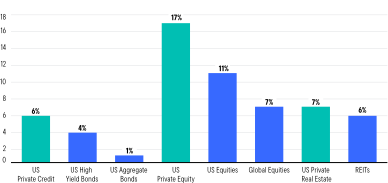
Sources: MSCI Indices, SPDJI, Burgiss, Cliffwater, NCREIF, FTSE, Bloomberg, Macrobond, PitchBook (for the average fees for Private Credit). Analysis by Franklin Templeton Institute.
The indexes are total returns in US dollar terms. All returns are net of fees, valued on a quarterly basis. Indexes are unmanaged and one cannot directly invest in them.
Past performance is not an indicator or a guarantee of future results. Important data provider notices and terms available at www.franklintempletondatasources.com
Strategies to optimise allocation
The capital allocated to illiquid investments varies by investor and their liquidity profile. Many believe they should be 100% liquid, but this carries an opportunity cost, especially today. Traditional liquid market investments may deliver returns below historical averages, and investors may need to consider private markets to help achieve their goals.
Determining the appropriate percentage to allocate to private markets could involve developing an illiquidity bucket, as per the Yale example. In determining the size of the bucket, factors to consider include short- and long-term liquidity requirements, significant upcoming expenses and how much of the portfolio investors are comfortable setting aside for 7–10 years. For many, a 10%–20% illiquidity bucket may be appropriate depending on wealth, income and cashflow needs.
Integrating alternatives
Once an illiquidity bucket is established, the next step is to determine the appropriate allocation to alternatives. Questions to ask here include:
- What are the overall goals and objectives?
- Which types of investments are most likely to achieve these goals?
- What is the most appropriate fund type?
- What is the optimal combination of asset classes (traditional and alternatives)?
- What is the appropriate amount of capital to allocate per strategy?
Global family office allocations
Family offices have historically made significant allocations to alternative investments
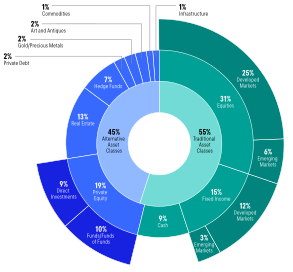
Source: 2023 UBS Global Family Office Report.
Holding for the long term
The human brain, our original personal computer, can perform complex computations and process information rapidly. However, unlike personal computers, the human brain also responds to emotional stimuli, such as fear, greed and pain, in an irrational manner.
Nobel Prize winner Daniel Kahneman conducted groundbreaking research in behavioural finance, studying how the brain responds to stimuli and the biases we exhibit. One key concept he explored is “loss aversion”, where investors go to great lengths to avoid losses. For the average investor, the ratio of avoiding losses to seeking gains is roughly 2:1. This behaviour often leads investors to be overly conservative or to exit the market during periods of volatility, potentially falling short of their goals.
Allocating part of a portfolio to illiquid investments can help mitigate this behaviour. Illiquid investments remove the emotional impulse to sell or switch strategies during volatile times. Investors cannot sell at the first signs of volatility or be tempted to chase returns elsewhere. These assets are truly long term in nature and require patience and discipline to reap the full benefits.
Conclusion: Embracing illiquidity for future success
There is a potential illiquidity premium for allocating capital to private markets and another benefit is that fund managers are given ample time to execute their strategy and unlock value. There is an opportunity cost to being too liquid, especially in today’s market. Investors should determine their illiquidity bucket based on their ability to allocate capital for an extended period, promoting a long-term disciplined approach that counters emotional impulses.
Thanks to recent advancements by European regulators, investors can now aim to fill their illiquidity buckets. Regulations such as the European Long-Term Investment Fund (ELTIF), Part II Undertaking for Collective Investment (Part II UCIT) and Long-Term Asset Fund (LTAF) have introduced fund structures that democratise access to private markets. Each vehicle offers diverse investment and liquidity characteristics, enabling investors to choose the best option based on their needs.
- Source: David F. Swensen, “Pioneering Portfolio Management: An Unconventional Approach to Institutional Investment.” 2009.
- Source: Yale University. FY23 Financial Report.
- Source: “The Illiquidity Premium and the Market for Private Assets. Portfolio for the Future.” CAIA.
- Source: 2023 UBS Global Family Office Report.